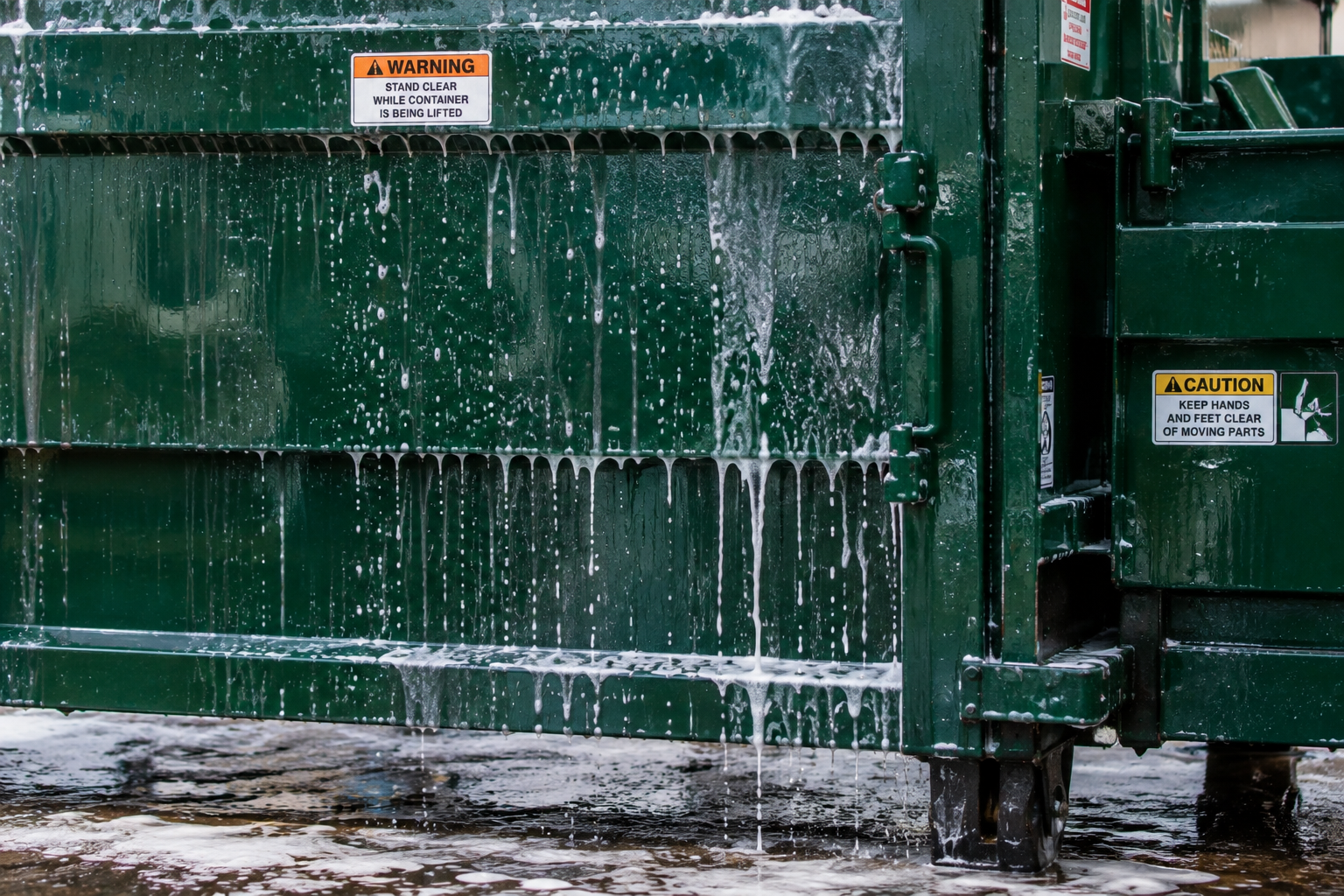
The compactor out back is the one thing on your property nobody wants to look at, which is exactly why it turns into a problem. There’s a lot of loose talk about EPA fines in this corner of the business, so let’s get it right, because the real picture is honestly scarier than the myths, just for a different reason. Environmental penalties are set by law, bumped up every year for inflation, and charged per day, per violation. That last part is the kicker. One unresolved problem doesn’t earn you a single fine. It earns you a fine for every day it sits there.1
So let’s walk through what actually applies around a compactor, the real numbers, and the one mistake well-meaning operators make that can turn a cleaning into a violation. These figures come from the federal penalty schedules, not from some invented average. And the goal isn’t to frighten you with a headline, it’s to show why an ignored waste area is worse than one fine makes it sound, and why a modest, regular cleaning is the cheapest way to keep the whole thing closed.
The EPA is required by law to raise its maximum penalties every year to keep up with inflation, and those maximums steer how aggressive the agency gets.1 Under the Resource Conservation and Recovery Act, the law that governs waste handling, the inflation-adjusted maximum reached roughly $93,058 per day, per violation as of the 2025 adjustment for the relevant provision.2 Those big numbers apply most directly when hazardous waste is involved, and the per-day, per-violation piece is what really matters. Every separate requirement can count as its own violation, so a handful of small failures found on the same day multiply in a hurry.
For you, the exact dollar figure matters less than the shape of it. Penalties pile up daily, stack per violation, and climb every year. A problem left alone for weeks isn’t a fixed cost, it’s a growing one. That’s true across all the environmental rules, which is why a neglected waste area is a bad thing to gamble on. An operator who figures one fine is the worst case is misreading the whole system, because the real danger is the compounding. A mess nobody caught for a month is a mess that, on paper, was racking up exposure every single one of those days, which is exactly the situation a regular cleaning schedule is built to make impossible.
Here’s the one that catches good operators off guard: the cleaning itself can create a violation if the wash water isn’t handled right. Blast a filthy compactor pad and you send contaminated runoff, full of grease, rotting food, and whatever cleaner got used, straight toward the nearest storm drain. Letting that run into the storm system is a regulated act under the Clean Water Act, and like the other environmental rules, its penalties are charged per day, per violation and rise every year, well into the tens of thousands of dollars a day.1 In other words, you can fix a waste problem and create a stormwater problem in the same afternoon.
This isn’t some rare edge case. It’s one of the most common ways a compactor cleaning goes sideways, and it’s completely avoidable. The right way uses reclamation: cover and sandbag the drains, then vacuum the dirty water back up and haul it off for proper disposal instead of letting it run. Pair that with biodegradable, non-hazardous cleaners and you stay well inside the lines. So when you’re deciding who cleans your compactor area, this is the question that matters most, because a crew that doesn’t reclaim its wash water is handing you the exact discharge violation the cleaning was supposed to prevent.
Federal rules are only part of the story, and for most grocery and restaurant operators, the more frequent trouble comes from your state and local health department. A neglected compactor breeds larvae, draws rodents and roaches, and throws off the odor and filth that local codes exist to police. And here’s why that’s the real headache: pests don’t stay at the compactor. They head for the building, and a pest problem inside your food area is a far bigger deal than any single fine. That’s a failed health inspection, maybe a closure, destroyed product, and a reputation hit that outlasts the pests. The compactor is often where that whole chain starts, which makes cleaning it a food-safety move as much as an environmental one.
Most places handle compactors reactively. They clean when it stinks, when pests show up, or when an inspection scares them, which means the area is always one bad week away from a violation or a failed check. The better move is to treat it like you already treat your HVAC or fire systems: a scheduled task with a set frequency and scope. That shift isn’t just tidier, it changes the money. A scheduled facility never lets the area reach citation or infestation condition in the first place, so the cost becomes a predictable line item instead of an emergency, and your good-faith compliance record builds itself month after month. EPA penalty policy actually weighs those good-faith efforts, so a dated record of regular cleaning, with photos, is real evidence in your corner if anything ever comes up.2
One more upside: regular cleaning protects the compactor itself. Compacted waste and corrosive organic acids sit against the metal, hydraulics, and seals and wear them down over time, so a unit cleaned on a schedule tends to last longer and need fewer repairs. The machine is expensive to replace. Cleaning is a cheap way to protect it. If you run multiple locations, standardizing the program across every site is what keeps the total exposure from growing right along with your store count.
It’s worth being clear about which rules actually apply, because the loose talk blurs it. The biggest per-day RCRA penalties attach to hazardous waste, which most grocery and restaurant compactors don’t primarily handle. For a typical retail or food compactor, the more realistic federal risk is a Clean Water Act discharge from uncontained wash water, and the more frequent enforcement is your local health and pest-control codes. That’s not a reason to relax, it’s a reason to focus. For most operators the everyday risks are stormwater discharge and pest-and-sanitation issues, and both get solved by the same thing: cleaning the area on a schedule with the wash water contained. Match the response to the real risk and you spend your cleaning dollars where they actually protect you.
It is worth picturing what proper compactor cleaning even looks like, because it is a lot more than spraying the thing down. A real job starts by protecting the drains so nothing contaminated escapes, then breaks down and cleans the compactor, the pad, and the surrounding area, getting into the spots where leachate pools and pests breed. The wash water gets vacuumed back up and hauled off rather than left to run into the storm system. Biodegradable products do the heavy lifting so you are not trading a waste problem for a chemical one. And the whole thing gets documented with dates and photos, so you have a record that the area is maintained.
Compare that to the reactive version, where somebody grabs a hose after a bad smell gets bad enough to complain about. The quick rinse pushes contaminated water toward the drain, misses the buildup that actually draws pests, and leaves you with nothing to show an inspector. It feels cheaper in the moment and costs more in every way that matters. Doing it right the first time, on a schedule, is the version that actually keeps the area clean and keeps you out of trouble, and it is not meaningfully more expensive once it is routine. The reactive scramble only feels cheaper because you are not counting the fine, the failed inspection, or the emergency you are one bad week away from.
The accurate story isn’t a scary invented stat, it’s the real shape of the rules. Environmental penalties run per day, per violation, they climb yearly, and the cleaning itself can trigger a stormwater violation if the wash water isn’t contained. Add the local health-code and pest risk and the case for scheduled, done-right cleaning is strong. Gleam cleans compactor areas using reclamation and biodegradable products, so the work cuts your waste-storage and pest exposure without creating a discharge problem, and it comes with dated records that show good-faith compliance if a question ever arises. The result is a waste area handled on a schedule instead of in a panic, quietly off the radar of both regulators and local inspectors.
Q: How are EPA fines around waste actually figured?
A: They’re set by law, raised yearly for inflation, and charged per day, per violation. Under RCRA, the inflation-adjusted maximum reached roughly $93,058 per day per violation for the relevant provision in 2025. That per-day, per-violation setup is what makes an unaddressed problem grow fast.
Q: Can cleaning a compactor really cause a violation?
A: Yes. If wash water full of grease and food waste runs into a storm drain, that discharge is regulated under the Clean Water Act, with its own per-day, per-violation penalties. That’s why reclamation, covering drains and vacuuming up the wash water, is essential.
Q: What is reclamation and why does it matter?
A: It means covering and sandbagging the drains, then vacuuming the dirty wash water back up for proper disposal instead of letting it run off. It keeps a compactor cleaning from becoming a stormwater violation. A crew that skips it puts you at risk.
Q: Isn’t the bigger risk really local health inspections?
A: For most grocery and restaurant operators, yes. Neglected compactors breed pests and odor that violate local health codes, and pests moving into the food area can mean a failed inspection or closure, which hurts more than most fines. The compactor is often where it starts.
Q: Does documentation help with compliance?
A: Yes. EPA penalty policy weighs good-faith compliance efforts, so a dated record of scheduled cleaning with photos supports you if a problem ever comes up. It shows the area is maintained on a schedule rather than ignored.
Q: How often should compactors be cleaned?
A: High-waste places like grocery stores and restaurants generally need monthly at minimum, with the busiest locations going bi-weekly. Lower-volume sites can often run quarterly. Any leachate or pest activity between cleanings should be handled right away.
Take a look at your compactor and pad this week for buildup, odor, leachate, and pests, and note where the drains are near it. Then get the area on a regular schedule handled by a crew that reclaims its wash water. Gleam does exactly that, with biodegradable products and dated records, so you cut your real exposure without creating a new one. Get in touch at iwantgleam.net.
1. U.S. EPA, Civil Monetary Penalty Inflation Adjustment (Federal Register, January 2025); EPA penalties are assessed per day, per violation across RCRA, the Clean Water Act, and other statutes.
2. RCRA civil penalty provisions, inflation-adjusted maximums (42 U.S.C. 6928), as reported in 2025 regulatory analyses; EPA RCRA Civil Penalty Policy weighs good-faith compliance efforts.

.svg)
.svg)
.svg)


© 2025 Gleam. All rights reserved. · Privacy Policy · Terms of Service