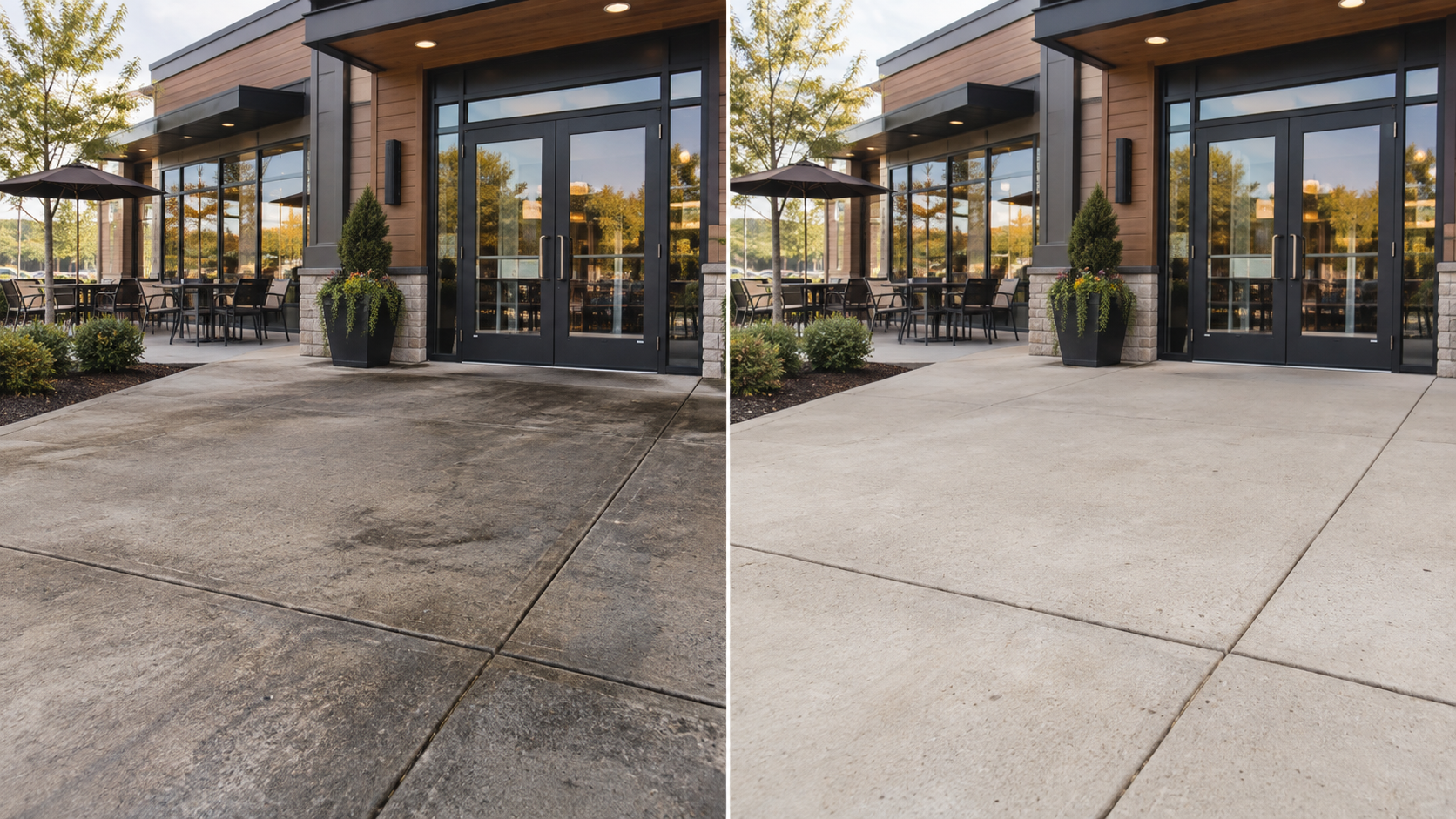
Ask any restaurant owner what keeps people coming back, and almost all of them will say the food. Fair enough. But the research tells a slightly humbling story: cleanliness matters just as much, and sometimes more. In one Technomic consumer survey, 93% of diners said cleanliness is important or very important when they pick a restaurant. That actually beat the 89% who said the same about the cleanliness of the kitchen.1 Read that again. The impression of clean is pulling as much weight as the reality of it, and that impression starts before anyone tastes a thing. It starts on your sidewalk.
So let’s talk about the front of your building, because it’s the part most owners forget and one of the cheapest to get right. None of this is guesswork. The numbers below are real, and they all point the same direction: your entrance is quietly making the sale, or quietly losing it, in the few seconds before a customer decides to walk in.
Here’s the finding that surprises people most. When diners decide whether to come back, cleanliness tends to outweigh service. A long-running Cintas survey run by Harris Interactive found that how clean a place felt, the smells, the surfaces, weighed more heavily on the return decision than slow or spotty service did.2 Other industry data lands in the same spot: roughly 73% of diners put cleanliness in their top three factors for a sit-down restaurant, ahead of ambiance and even service.3 We spend so much energy training staff and tweaking the menu, which absolutely matter, and treat cleaning like a chore we’ll get to. Your customers don’t rank it that way at all.
There’s a second finding that connects your front door straight to your kitchen, at least in the customer’s head. That same Cintas research found 86% of adults judge a restaurant’s kitchen by how clean its restroom is.2 People take what they can see and use it to guess at what they can’t. And the very first thing they can see isn’t your restroom, it’s your entrance. Gum stuck to the concrete, a greasy walkway, cloudy glass. Every bit of that is telling a story about the parts of your operation they’ll never lay eyes on. It’s not fair, but it’s how people think, and it happens before they’re even inside.
We like to imagine customers form their opinion once they’re seated. They don’t. The judgment fires in the first few seconds of contact, and for a restaurant that contact happens in the parking lot and on the walk up, not at the host stand.1 The path from the car to the door, the state of the windows, whether there’s gum and grime underfoot, that’s the raw material people use to decide if this looks like a place that cares about its food. Nobody does it consciously. It’s a gut read, and it’s already formed by the time they reach the handle.
That’s why the exterior punches above its weight. You can run a spotless kitchen and a sharp team and still lose someone at the curb because the approach looked tired. The upside is that it works in reverse too. A clean, cared-for entrance sets a good expectation, and then the rest of the visit just gets to confirm it. It is a whole lot easier to live up to a good first impression than to claw your way out of a bad one.
Appearance doesn’t just shape the walk-in. It feeds your reviews, and reviews are where the money shows up in black and white. Researchers at Harvard Business School found that bumping a restaurant’s Yelp rating by a single star lined up with a 5% to 9% jump in revenue.4 Now consider that cleanliness is one of the most common themes in bad reviews, and that restaurants get hit harder by cleanliness complaints than almost any other kind of business. When your place looks genuinely well kept, inside and out, people are more likely to mention it in a good way and far less likely to torch your rating over a grimy first impression. Most diners read reviews before they choose you, so that rating is a lever, and cleanliness is one of the few inputs you fully control.
Line it all up and the front walkway stops looking like an expense. It nudges the decision to come in, the decision to come back, and the reviews that bring in the next person. Every one of those is revenue, and they all begin at your entrance.
There’s a practical reason restaurants struggle to keep the exterior looking right on their own. The two biggest offenders at any entrance, grease and gum, laugh at a garden hose. Grease that’s soaked into concrete needs heat and a degreaser to actually break the bond and pull it out of the pores, not just push it around. Gum needs enough heat and the right touch to release cleanly instead of smearing into a gray halo. A quick rinse looks fine while it’s wet and goes right back to grim once it dries. A real hot-water cleaning removes the stuff, and that’s the difference a customer’s eye catches on the way in, even if they couldn’t tell you why.
Restaurants have it a little worse, too. Grease drifts out from the kitchen and the trash area, spills happen near the door, and that’s exactly the buildup that reads as unsanitary. Getting into the corners, moving the mats and furniture to clean underneath, popping the gum, that’s not extra credit. That’s the part that produces the clean your customers are grading you on.
Since grime creeps back, when you clean matters almost as much as whether you do. The smart play is to get a thorough cleaning done right before your busy season kicks in, so your entrance is at its sharpest when the most people are showing up and every extra table counts. Through the busy months, a lighter monthly touch-up holds that look instead of letting it slide. In the slow stretches, quarterly keeps you from ever drifting into the neglected zone the research warns about. You’re spending where it does the most good and keeping the front of your building from ever looking rough.
If you run more than one location, that same logic says put every site on a standard schedule instead of cleaning whichever one starts looking bad. Clean reactively and there’s always at least one of your restaurants drifting toward that bad first impression, and you have no idea which one a given customer is judging today. A set schedule takes that gamble off the table, so every location is showing the clean face the survey data says people are grading. Bonus: it turns a random chore into a predictable line item, which is a lot easier to plan around.
Owners pour money into the things that move the dining decision: the menu, the interior, staff training, marketing. All of it matters, and all of it costs real money and real time to change. Your exterior is the odd one out. It’s a top-tier factor in whether people come in, and it’s one of the cheapest things on that whole list to fix. You can’t rebuild your menu for a few hundred bucks, but you can genuinely change the impression your entrance makes for about that, and keep it there for a modest monthly cost. For what it influences, your front walkway might be the best return on the property.
That’s the honest version of the pitch. A clean sidewalk doesn’t replace good food or good service. It sits right next to them as something your customers care about a lot, and often weigh first, before they’ve experienced anything else. The exterior is simply where all that judging begins. Treat it like part of how you win customers, not like janitorial overhead, and you’re finally matching how people actually experience your restaurant. Think of it this way: you would never let your dining room go a month without a wipe-down, yet the entrance is the room every single customer sees first, and it is standing out in the weather collecting everything the parking lot throws at it. It deserves at least the same attention as the tables inside.
You don’t need a made-up case study to justify any of this. The consumer research is clear and it’s consistent. Cleanliness is a top reason people choose a restaurant, come back to it, and review it, and it often outranks service. Your exterior is the first and cheapest place to shape all three, because it’s the first thing anyone sees. Gleam can put your entrance and storefront on a simple schedule timed to your busy season, so the front of your building is helping you win customers instead of quietly costing you a few. Reach out through iwantgleam.net and we’ll set it up.
Q: How much does cleanliness affect where people choose to eat?
A: A lot. In a Technomic survey, 93% of diners said cleanliness is important or very important when choosing a restaurant. Other data puts cleanliness in the top three factors for about 73% of diners, ahead of ambiance and service.
Q: Does cleanliness really matter more than service?
A: Often, yes. Cintas survey research found that how clean a place feels weighs more heavily on whether people return than poor service does. Owners tend to prioritize service and menu, while customers weigh cleanliness at least as heavily.
Q: Why does the outside matter if the food is great?
A: Because people judge in the first few seconds, before they taste anything, and they use what they can see to guess at what they can’t. Research shows diners equate visible cleanliness with the kitchen, so a grimy entrance signals a dirty operation whether it’s true or not.
Q: Is there a real money link between cleanliness and sales?
A: Yes, through reviews. Harvard Business School research found a one-star bump in a restaurant’s Yelp rating lined up with a 5% to 9% revenue increase. Cleanliness is a leading theme in negative reviews, so it directly shapes the rating that pulls in future customers.
Q: Can’t we just hose down the sidewalk ourselves?
A: Grease and gum, the worst offenders, don’t lift with cold water and low pressure. They need heat, a degreaser, and the right technique. A rinse looks clean while wet and returns to the same state dry, which is why a professional hot-water cleaning looks noticeably different.
Q: How often should a restaurant exterior be cleaned?
A: For most places, monthly during your busy season keeps the entrance sharp when traffic is highest, with quarterly service in slower stretches to hold the baseline. Heavy grease and high foot traffic push toward more frequent cleaning.
Walk your own entrance the way a first-timer would, from the parking spot to the door, and really look at the walkway, the threshold, and the glass. If any of it reads as neglected, that’s the impression forming before anyone sits down. Gleam can put your entrance and storefront on a simple schedule built around your busy season. Reach out at iwantgleam.net.
1. Technomic Consumer survey, reported by Restaurant Business Online, “Boosting consumer perception of restaurant cleanliness.” (2025).
2. Cintas Corporation survey conducted by Harris Interactive, reported by QSR and FSR Magazine. (Survey of 1,008 U.S. adults).
3. Restaurant cleanliness consumer research, reported by Dining Alliance, “A Clean Restaurant Is a Profitable Restaurant.” (2026).
4. Harvard Business School (Michael Luca), “Reviews, Reputation, and Revenue: The Case of Yelp.com.”

.svg)
.svg)
.svg)


© 2025 Gleam. All rights reserved. · Privacy Policy · Terms of Service